April 17, 2026 • Callum Draper • 9 min reading time • Prices verified June 6, 2026
Decoding the All-in-One Electric Brewing Market: VEVOR vs Grainfather G30 vs BrewZilla vs Brewer's Edge
If you’ve ever stood in front of a stovetop with a 10-gallon pot balanced over two burners, you already understand why all-in-one electric brewing systems exist. These are self-contained brewing kettles — typically 35 to 65 liters — with a built-in heating element, a recirculation pump, and a malt pipe (a perforated basket that holds your grain while hot water flows through it). You plug one in, add water, add grain, and brew. No propane tanks, no scorching the kitchen ceiling, no juggling three vessels on a crowded patio. For brewers ready to step up from extract kits (pre-processed malt syrups) to all-grain brewing (mashing whole crushed grain to extract fermentable sugars yourself), an all-in-one system is often the logical first serious purchase.
This article compares four systems that keep showing up in the same decision window in mid-2026: the VEVOR (budget entry), the BrewZilla Gen 4 (mid-range workhorse), the Brewer’s Edge Mash & Boil (simplified mid-tier), and the Grainfather G30 (the prosumer flagship). We’ll show you the specs side by side, surface what owners and long-run reviewers consistently report, and end with a clean decision rule for each buyer type.
| EDITOR'S PICK[Kegla BrewZilla Gen 4 - Wifi/Ra…](https://www.amazon.com/dp/B0CG2Q27VG?tag=greenflower20-20) | Mid-tier[Brewer's Edge Mash and Boil Ori…](https://www.amazon.com/dp/B09N2W8XKT?tag=greenflower20-20) | Budget pick[VEVOR Electric Brewing System](https://www.amazon.com/dp/B0B4SZT6X1?tag=greenflower20-20) | |
|---|---|---|---|
| Volume | 35L | — | 35L |
| Wifi | ✓ | — | — |
| Pump included | ✓ | — | ✓ |
| Voltage | 110V | — | — |
| Power | — | — | 100-1800W |
| Price | $599.99 | $369.95 | $248.90 |
| See on Amazon → | See on Amazon → | See on Amazon → |
By the Numbers: Side-by-Side at a Glance
| System | Volume | Wattage | Pump | Street Price (May 2026) |
|---|---|---|---|---|
| VEVOR 35L All-in-One | 35 L | 1,500 W (120V) | Yes | ~$160–$200 |
| BrewZilla Gen 4 35L | 35 L | 2,200 W (240V) / 1,600 W (120V) | Yes (dual) | ~$350–$400 |
| Brewer’s Edge Mash & Boil | 35 L | 1,600 W (120V) | No | ~$300–$350 |
| Grainfather G30 | 30 L | 2,000 W (240V) / 1,400 W (120V) | Yes | ~$900–$950 |
Prices sourced from aggregated retailer listings as of publication. Street prices shift with promotions and inventory cycles — always confirm at checkout.
The Four Systems, Examined One by One
VEVOR 35L: Honest About What You’re Buying
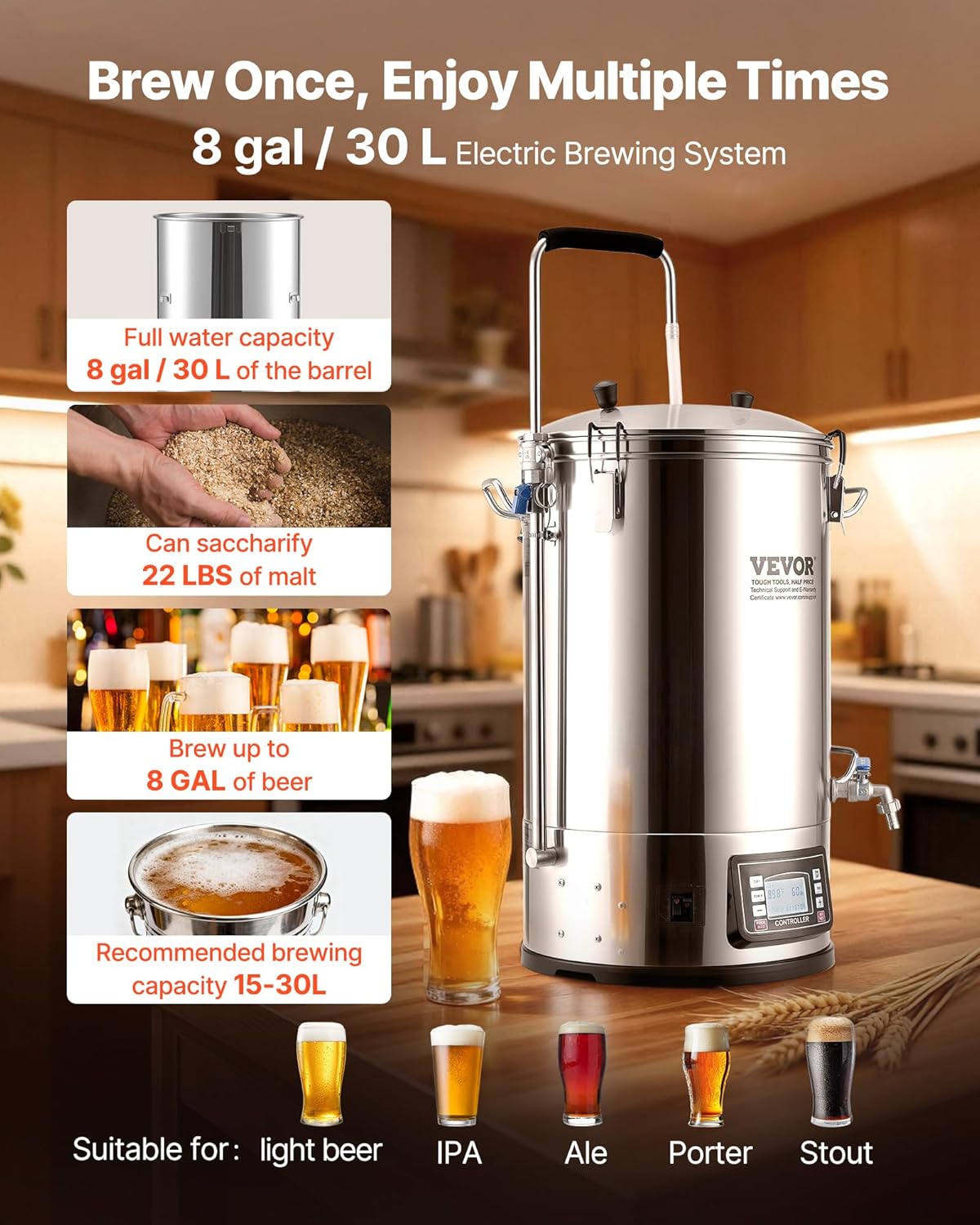
The VEVOR all-in-one (typically marketed as a 35-liter or 65-liter “home brewing system”) has become the entry point that budget-minded brewers either love or outgrow fast. At $160–$200, it undercuts every named competitor by a wide margin — and that gap is real, not a rounding error.
VEVOR ships a 120V/1,500W element, which is the minimum wattage you’ll find in this category. According to MoreBeer Articles’ overview of electric system selection (“Choosing Your First All-Grain Electric Brewing System”), sub-1,600W elements on standard 120V circuits will achieve a rolling boil on 35-liter batches but may take 45–60 minutes longer to reach strike temperature than a 240V unit — a meaningful factor on brew day if your time is limited.
Owner experience across published reviews indicates that the recirculation pump is functional but noisier and less consistent than the pumps on BrewZilla or Grainfather units. The sparge arm — a rotating sprinkler that distributes water evenly over the grain bed — is absent or flimsy on many shipped versions. The PID temperature controller (the digital thermostat that holds your mash at a precise temperature like 152°F) is described in aggregated reviews as workable but imprecise, with some owners noting ±3–4°F variance compared to the ±1°F that the Grainfather advertises in its published specifications.
Craft Beer & Brewing Magazine’s all-in-one electric brewing system roundup notes that precise mash temperature control is one of the two variables most directly separating beginner-range mash efficiency (65–72%) from intermediate-to-advanced efficiency (78–88%) on all-grain systems. The VEVOR’s temperature control limitations will become the active constraint before its physical volume does.
The honest tradeoff: The VEVOR will produce real beer. Its ceiling is simply clear. If you’re already planning to brew 20 or more batches per year, the upgrade cost you’ll pay in 18 months exceeds the price gap between VEVOR and BrewZilla today.
VEVOR
$248.90
In stock on Amazon
Check price on AmazonBrewZilla Gen 4: The Community Favorite for Good Reason
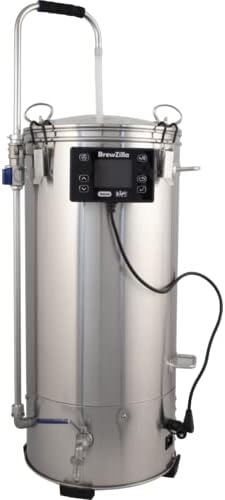
The BrewZilla Gen 4, made by Kegland and widely distributed in North America, occupies the sweet spot that most intermediate brewers eventually converge on: dual-pump recirculation, a solid PID controller, a 240V option for faster heating, and a built-in temperature probe on newer versions. At $350–$400 street price, it costs roughly twice the VEVOR and about a third of the Grainfather — and most owners report performance that trends closer to the latter.
BYO (Brew Your Own) magazine’s Electric Brewing Systems Buyer’s Guide highlights the Gen 4’s dual-pump design as a meaningful upgrade over single-pump predecessors. One pump handles recirculation through the malt pipe during the mash; a second handles wort transfer to the fermenter without manual siphoning or a separate transfer pump. Owners consistently report brew days running 30–45 minutes shorter than equivalent single-pump setups because step transitions are faster and cleaner.
The 240V version (2,200W) is preferred over the 120V version by owners in climates where boil vigor is a priority. Brulosophy’s published documentation on recirculating infusion mash systems notes that vigorous boil drives off DMS (dimethyl sulfide, a cooked-corn off-flavor common in pale lagers and pilsners) more effectively than a low rolling boil — a practical argument for the 240V circuit if your space is already wired for a 240V dryer or range outlet.
BeerSmith Blog’s treatment of electric brewing system volume math raises one notable limitation: a 1.080 OG recipe (a strong ale requiring roughly 17–19 lbs of grain for a 5-gallon batch) will challenge the 35-liter malt pipe, leaving less headroom for water volume than high-gravity brewers want. The BrewZilla’s controller interface is also described by owners as programmable but not intuitive on first use. App connectivity on older Gen 4 firmware has received mixed reviews; the Grainfather’s app is consistently rated more stable across long-run user reports.
The honest tradeoff: For standard to moderate-gravity beers (OG up to 1.070), the BrewZilla Gen 4 is the clearest value in this comparison. For high-gravity brewing or app-dependent brew day management, its limitations become real.
Brewer's
$369.95
In stock on Amazon
Check price on AmazonBrewer’s Edge Mash & Boil: The Simplified Option With a Real Tradeoff
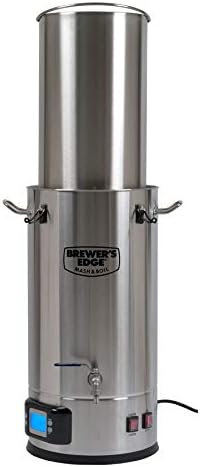
The Mash & Boil from Brewer’s Edge, distributed by MoreBeer and widely stocked at homebrew retailers, makes a deliberate design choice that sets it apart from every other system in this comparison: no recirculation pump. At $300–$350, it sits in the same price tier as the BrewZilla but takes a fundamentally different philosophy — passive lautering (draining wort through the grain bed by gravity) rather than active recirculation.
MoreBeer Articles’ system selection content positions the Mash & Boil as an ideal choice for brewers who want all-grain simplicity without managing pump priming, flow rates, or stuck-sparge troubleshooting. The tradeoff is documented and measurable. Brulosophy’s published comparisons between recirculating and non-recirculating mash systems show that RIMS-style recirculation — as provided by the BrewZilla and Grainfather — typically yields 4–8% higher mash efficiency than passive systems under equivalent grain bills and water chemistry. In practice, that means Mash & Boil brewers either purchase and mill more grain per batch or accept lower pre-boil gravity readings compared to what a recirculating system would produce from the same recipe.
The Mash & Boil’s 1,600W / 120V heating element is slightly more capable than the VEVOR’s 1,500W unit, and owners report more consistent temperature stability during the mash. For brewers stepping up from BIAB (Brew-in-a-Bag, a simpler all-grain method with no separate malt pipe) who find pump-equipped systems intimidating, the Mash & Boil is a reasonable bridge.
The honest tradeoff: The pump-free design is simultaneously the feature and the limitation. If mash efficiency matters to you — and at the intermediate-practitioner level it usually does — you’ll spend more on grain over time to compensate, which partially erodes the price advantage over the BrewZilla over a brewing season.
Brewer's
$369.95
In stock on Amazon
Check price on AmazonGrainfather G30: When the Premium Is Actually Justified
The Grainfather G30 lists at $900–$950 — more than double the BrewZilla, nearly five times the VEVOR. That number demands a real justification.
Here is what the price buys, per published specifications and consistent owner reporting across multi-year reviews: a counterflow wort chiller included in the base kit (cooling hot wort before it reaches your fermenter, a step that requires a separate $100–$150 purchase with every other system in this comparison), Grainfather’s Connect controller with a Bluetooth app that owners consistently rate as the most stable and polished app experience in the all-in-one category, and a stainless steel build that owners in three-to-five-year ownership reviews describe as showing minimal wear.
Craft Beer & Brewing Magazine’s all-in-one roundup specifically identifies the Grainfather’s integrated counterflow chiller as the feature that most meaningfully changes the brewing workflow: where BrewZilla or Mash & Boil owners need to budget separately for an immersion chiller or plate chiller, the G30 owner is already configured for a closed-loop chill directly into the fermenter. When you add a $100–$150 chiller to the BrewZilla’s price, the effective gap between the two systems narrows to roughly $450–$500 — still significant, but a more honest comparison.
BeerSmith Blog’s notes on electric system selection document the G30’s 2,000W / 240V element as producing a vigorous, controlled boil with effective DMS drive-off and consistent hop utilization across repeated brew sessions. At 30 liters nominal capacity (versus 35 liters on the other three systems), the G30 runs slightly smaller — a factor worth noting if you routinely brew high-gravity recipes with large grain bills.
The Grainfather is expensive to repair outside warranty, and third-party parts availability is thinner than for the BrewZilla or Mash & Boil. Owners who brew two to three times per month over multiple years consistently report satisfaction; owners who brew six to eight times per year sometimes find the premium harder to justify over time.
The honest tradeoff: The G30 is the system to buy and stop thinking about — if you’re brewing seriously and often. If you’re still calibrating how often you’ll actually brew, start with the BrewZilla and revisit.
Kegla
$599.99
In stock on Amazon
Check price on AmazonThe Decision Rule, Summarized
All-in-one electric brewing systems are not commodity purchases. Each one represents a set of workflow assumptions you’ll live with for years. Here is the framework, plain:
- Under $250, just starting all-grain: VEVOR. Accept the temperature-control limitations and learn on it. Upgrade when efficiency becomes your constraint, not before.
- $350–$400, access to 240V, efficiency matters: BrewZilla Gen 4. The community data behind this system is deep, the dual-pump workflow is faster, and the value at this price tier is genuine.
- $300–$350, coming from BIAB, pump-averse: Brewer’s Edge Mash & Boil. A simpler path into all-grain, with a real efficiency ceiling to understand going in.
- $900+, brewing seriously twice a month or more, want to stop upgrading: Grainfather G30. The sticker narrows once you price in the included chiller and a multi-year ownership horizon.
Three inputs will narrow these four options to one before you ever read a spec sheet: your expected brew frequency, your typical grain bill size, and whether your brewing space has a 240V outlet available. Know those three things first. The rest of the decision follows naturally.
The all-in-one market has matured enough that there is no genuinely bad choice at any price tier — only mismatches between what a system is designed to do and what you actually need it to do.